Title
Description of package

Description of package
In the last 5 years, there has been a notable evolution in the domain of open-source software managed hosting providers. Initially, before the emergence of Nextcloud managed hosting, there were traditional hosting providers primarily focused on offering domain names and basic hosting services, often utilizing proprietary platforms like cPanel and WHMCS. However, these offerings lacked comprehensive management and qualitative user support, focusing mainly on downtime management. With the advent of solid open-source solutions such as Nextcloud, many enthusiasts individuals began offering hosting services bundled with features like software deployment and server uptime management. Initially, the emphasis was on affordability, often with individuals or small teams covering individual or small teams needs. However, gradually this approach proved unsustainable as providers faced additional costs that were needed to offer managed hosting services. Some providers, like our team, opted not to engage in a pricing war but instead prioritized delivering value-driven services.
As more hosting providers entered the ecosystem, the team behind Nextcloud published on their website two lists of providers on their official website: approved ones (labeled as ‘Enterprise’), including those who pay a fee to be listed there, focused on large deployments, and other providers (labeled as Private Use) like ourselves that focus on small and medium teams. It is important to clarify that in our case the term ‘Personal Use’ does not apply, as we focus on serving small and medium teams and rarely individuals choose our team for their Nextcloud managed instance. We understand that we can not influence how the Nextcloud team labels managed hosting teams like ours though.
In addition, the Nextcloud managed hosting landscape now comprises both providers deeply committed to open-source principles and those primarily focused heavily on big commercial interests that offer enterprise contracts. But what does it take to be a small-by-design provider (like ourselves) to offer managed hosting services for Nextcloud? Here is a list covering only a portion of the daily tasks that need to be implemented for a qualitative service.
Nextcloud managed hosting providers that aim to simplify the migration from big tech to open-source solutions and handle various operations, need to focus on the following tasks, but should not be limited to:
Overall, any managed hosting provider should offer a complete package of support and solutions, empowering Subscribers to focus on their core business activities while entrusting the management of their online infrastructure to the chosen provider. This is not an easy task, as the list of requirements to offer a solid service is longer than the list mentioined above. Unfortunately, not every Nextcloud Managed hosting provider manages to deliver on all tasks mentioned, and when this happens, the impact of the bad practices followed has an impact on all the other providers that are part of the ecosystem.
As is the case with every ecosystem (or ‘industry,’ as some like to say), different teams offer varying levels of quality in their managed hosting service. We are aware (and frankly quite happy) of some very good Nextcloud managed hosting entities that offer top-notch services. These companies/coops/collectives take care of all the tasks mentioned above and ensure a solid and qualitative service with good uptime, excellent communication in tech and user support, automated backups, fair and compliant terms of service, and frequent software updates. Unfortunately, as is the case in every aspect of a service-oriented tech industry, not all providers can offer a good service in all aspects. One such Nextcloud provider was Owncube, which, based on the internet Archive, was an Austrian-based provider. Trustpilot reviews of the company were quite bad for a long time, with serious downtime incidents happening quite frequently (based also on comments on Reddit), followed by complaints about poor communication when incidents occurred. As a result, the team behind Owncube decided in January 2024 to inform all its users that they are ceasing operations in mid-February 2025 without giving much detail about what happened, at least from what we can understand from the comments online.
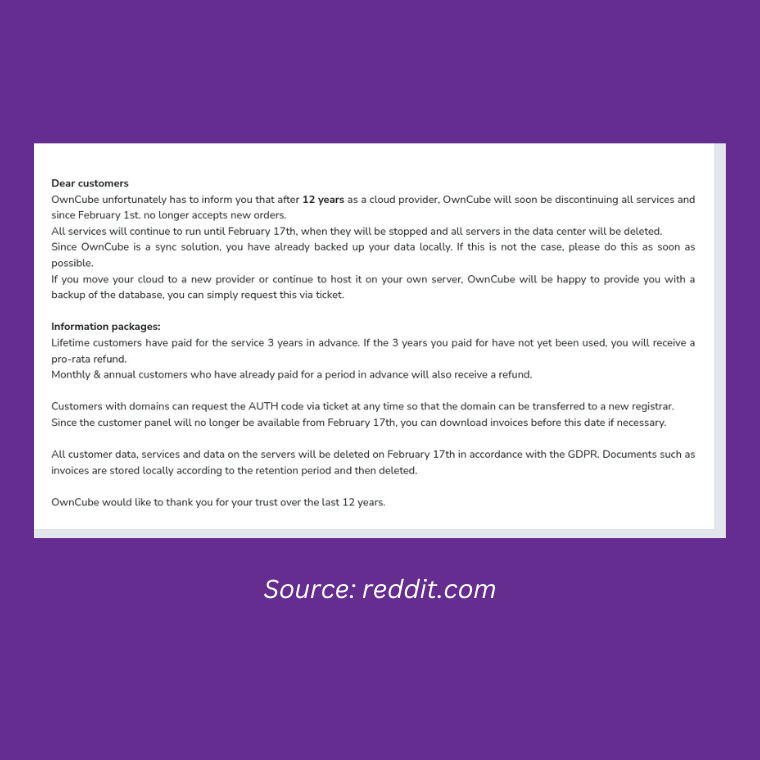
This shake-up in the Nextcloud ecosystem has the potential to make it harder for small and medium teams to migrate away from big tech or choose another Nextcloud Managed hosting provider. The Owncube incident especially has made small and medium teams realize that picking an open-source hosting provider isn’t a straightforward task. While using open-source software on a server sounds much better than choosing a big tech corporation, recent events show that SMEs need to be careful about who to trust with their digital infrastructure.
Before choosing the right hosting partner you’ve got to look at their track record, testimonials, how closely they adhere to open-source ethos, their technical and communication skills, aspects like Terms of Service and privacy policy, etc. Most importantly, you need to check if the provider you want to choose can really keep things running smoothly. Recent events are making everyone rethink how they pick their hosting provider, not just in Nextcloud but across the open-source world. After this incident, it seems to us that it will take a long time for small and medium teams to trust any managed hosting provider, and this is a major issue, but it could also be an opportunity for Nextcloud hosting providers that are confident in the way they operate and their skills.
After carefully monitoring what happened to Owncube, we decided to write this blog post to share not only our thoughts but also our learnings from this incident. The goal is to improve even more our operational side of things and let our Subscribers or anyone interested in our services make an informed decision. Our take on the situation is that all providers of managed hosting services for open-source software should not only ensure that they have a plan in case of an emergency but also have established a well-planned business continuity plan.
An Operational (or business as some like to say it) Continuity Plan for a small, tightly-knit team is a structured strategy outlining procedures and protocols to ensure seamless operations during unforeseen disruptions. It encompasses comprehensive risk assessment, identifying potential threats such as natural disasters, technical failures, or personnel issues. The plan delineates key roles and responsibilities within the team, establishing clear communication channels and fallback mechanisms. It includes provisions for data backup and recovery, ensuring critical project files and resources are safeguarded. Additionally, it outlines protocols for remote work and collaboration tools, enabling the team to adapt swiftly to changing circumstances. Regular training and drills are integral to the plan, ensuring all team members are well-prepared to execute the plan effectively when needed. Overall, a solid Operational Continuity Plan empowers the team to navigate challenges with resilience and maintain productivity, fostering confidence among Subscribers and stakeholders.
Before detailing how we ensure that we take the trust from our Subscribers seriosly it is important to share some operational details about the way we offer our services.
Reading reviews from various Nextcloud hosting providers posted on the Nextcloud forum, there is a general feeling that our ecosystem is filled with single-person companies that handle everything themselves. We have a totally different approach to this. Different team members work on different tasks, although there is constant communication among each team. For example, we have a communications team member ensuring everything is dealt with in the best way possible, the operations team ensuring that billing and costs are handled properly, the tech support team trained to address all questions and concerns, and the infrastructure team ensuring things are up and running securely. It is obvious that a single or two-person company would not be able to handle all these tasks not only on a daily basis but, most importantly, during a crisis similar to what happened to Owncube.
Documentation plays a pivotal role in our commitment to offer reliable open-source digital infrastructure. Both public-facing and internal documentation serve as the backbone of our operations, ensuring transparency, efficiency, and reliability. Externally, comprehensive documentation not only facilitates your onboarding experience but also (and hopefully) fosters trasparency. Internally, documentation serves as a knowledge repository, enabling seamless collaboration among team members and preserving institutional memory. By investing in solid documentation practices, we truly believe that we uphold our commitment to providing reliable digital infrastructure for anyone interested in our services.
We have spent quite a lot of time ensuring that the way we operate and run our company includes planning for crisis management. As of today, our internal documentation and our Terms of Service give us lots of tools to tackle situations when operations are not feasible, but the Owncube incident made us reflect and imposes further improvement to our Business Continuity plan. Having said that, we want to emphasize our commitment to improving our BCP even more during 2024 and beyond.
It is clear to us that without continuous improvement not only from our team but from every open-source managed hosting provider, the chances of a similar situation like Owncube happening are high. We need to review and update our business continuity plans regularly to reflect changes in the team’s operations, technology infrastructure, or external threats, ensuring its effectiveness over time if we don’t want to have other similar crises, which will have a bigger impact on the trust of all the small and medium teams that want to migrate away from big tech. We can do this individually as separate teams or some parts of it collectively with other managed hosting providers including but not limited to CHATONS. Are you up for it? If the answer is yes, then let’s get in touch!

Posts from our team.